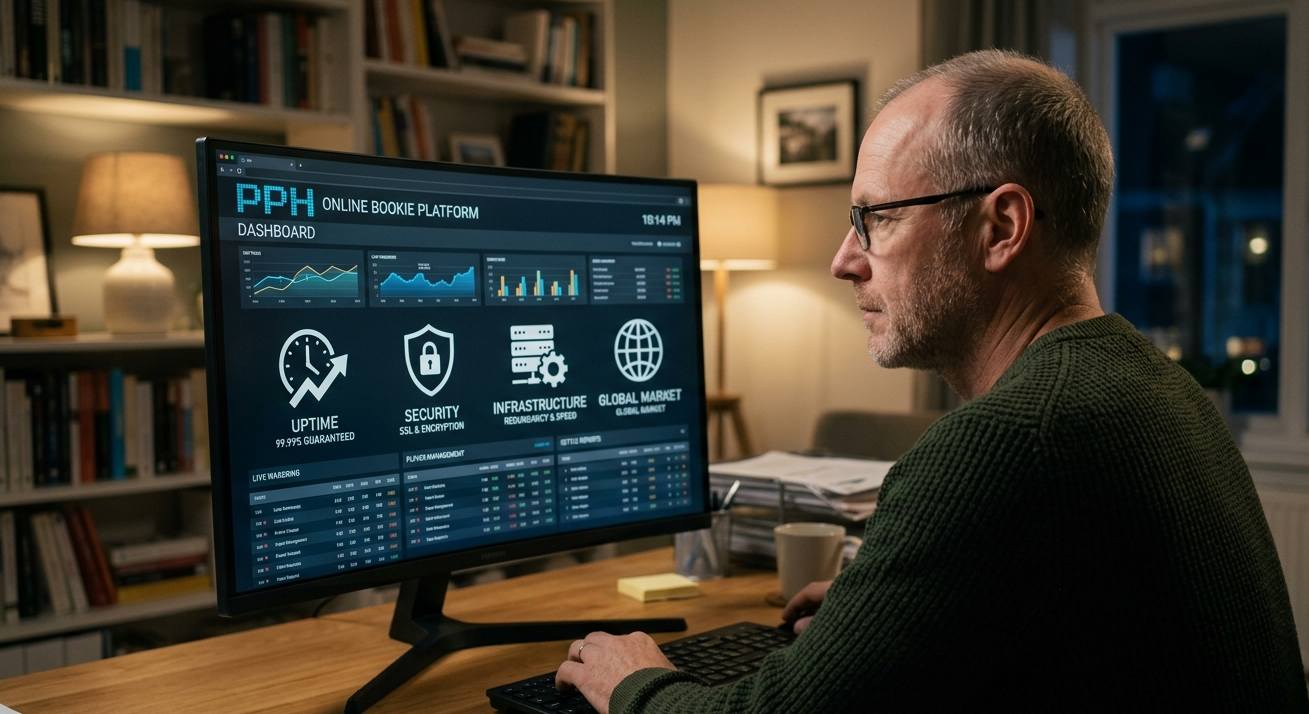
Most operators spend too much time evaluating the wrong things. They look at the betting menu, the interface design, and the per-head price. What they rarely look at closely enough, until something goes wrong, is the infrastructure underneath. In 2026, with betting volumes higher than ever and player expectations shaped by the best consumer tech, the difference between a platform that holds up and one that cracks under pressure comes down to engineering decisions most agents never see.
Let’s discuss the technical fundamentals that actually determine whether a PPH platform is worth trusting with your business: uptime, architecture, security standards, data infrastructure, and how to evaluate all of it before you commit.
How Does Pay-Per-Head Work from a Technology Perspective?
Most people understand the billing side of the model – you pay per active player per week. But how does pay-per-head work at the infrastructure level? That part gets less attention, and it’s where the real quality differences live.
When you log into your price-per-head sportsbook dashboard, you’re accessing the front end of a complex, continuously running system. Underneath that interface, the provider is simultaneously managing live odds feeds from multiple data sources, processing bet requests in real time, maintaining player account states, and running automated grading systems after every event result.
The critical insight here: how does pay-per-head work when volume spikes? During peak events – an NFL Sunday, a heavyweight title fight, March Madness – that system needs to handle thousands of simultaneous transactions without a single lag. If the pay-per-head software isn’t built on an architecture designed to handle that load, slowdowns occur.
You’re not just buying a software interface, but betting your operation on the quality of someone else’s server infrastructure.
What “Price-Per-Head” Really Means for Platform Performance
The price-per-head fee you pay weekly isn’t just a margin for the provider. In a well-run operation, a significant portion of those price-per-head service fees gets reinvested directly into infrastructure – faster servers, redundant data centers, ongoing development, and 24/7 technical staff.
This is why chasing the lowest number on the page is a short-sighted move. A cheap pay-per-head provider offering $3 or $4 per head is cutting those costs somewhere, and it’s almost always in the infrastructure: shared servers, single data centers, minimal redundancy. Everything works fine until a major game weekend, when 10,000 operators all hit their platforms at once.
The pay price-per-head you choose signals what level of operational commitment you’re getting in return. A fair, transparent rate like PrimeTime PPH’s flat $10 per active head – with no hidden fees for live betting, casino, or prop builder access – tells you that the pricing is structured to sustain a serious operation, not just acquire customers with a low headline number.
Uptime: The Foundation of a Reliable Platform
If your platform is down, your business is down. There’s no partial credit in this industry. A player who tries to place a bet during a key game and hits an error message will go find another place to bet – and most of them won’t come back.
Price-per-head sportsbook software built for serious operators is built around redundancy. That means if one server fails, a backup takes over automatically. It means data centers are spread across geographic locations, so a regional power issue doesn’t take the whole platform offline. It means failover systems that engage in seconds, not minutes.
The price-per-head bookie operators who are last are the ones who chose platforms with this architecture in place from the start. Reliability isn’t something you can retrofit into a weak system. It has to be foundational.
PrimeTime PPH is built to stay up during the moments that matter most. See how the sportsbook platform is structured – from live betting infrastructure to real-time odds synchronization – before you make any commitments.
Security: Protecting Data and Transactions
The second pillar is security, and it’s non-negotiable. As a price-per-head bookie service, you’re holding player account data, transaction histories, and financial balances. That information has to be protected with the same seriousness as any financial service would.
What does proper security actually look like in price-per-head software for bookies? Start with end-to-end encryption on every connection between player devices and the server. Beyond that, robust platforms include DDoS protection to defend against attacks that aim to overwhelm servers with artificial traffic, anti-fraud monitoring to flag unusual betting patterns before they become a liability, and strict access controls so that account data can be accessed only by the right people.
The pay-per-head bookie software providers who get this right treat security as infrastructure, not an add-on feature. Breaches in this industry don’t just create legal exposure – they destroy the trust you’ve spent months building with your players.
At PrimeTime PPH, security is embedded at the platform level. If you have specific questions about how player data and transactions are handled, the FAQ section addresses the operational details directly.
Pay-Per-Head Free Trial: How to Test Security and Stability
A pay-per-head free trial is only valuable if you use it to test the right things. Most operators spend trial time browsing the interface and checking what sports are available. That’s the wrong priority.
Use the trial period to stress-test the platform under conditions that resemble real usage. Log in during a busy sports evening. Navigate quickly between site sections and measure how quickly each page loads. Check that live odds are actually updating in real time – not refreshing every 30 seconds on a delay. Submit a test action and see how fast the system responds.
Then test the support. Ask a technical question – something specific about the backend or how limits work. How fast do they respond? How detailed is the answer? Support behavior during a free trial is almost always a preview of support behavior when you have a real problem at 11 pm on a game night.
A trial that feels smooth and fast during off-peak hours is promising. One that already feels slow or inconsistent is a clear signal to keep looking.
Book a demo with PrimeTime PPH and walk through the platform live, including the backend tools, reporting dashboards, and live line interface, before making any decisions.
Infrastructure: What Powers Reliable Pay-Per-Head Software
Behind every reliable price-per-head sportsbook software product is a specific type of infrastructure. The best providers use cloud-based hosting combined with dedicated physical data centers – redundant systems that scale automatically as traffic grows without performance degradation.
The integration with external odds data feeds is equally important. To deliver accurate, up-to-the-second lines, pay-per-head software needs to pull from multiple data sources simultaneously and process that information faster than the market moves. Weak infrastructure creates lag in the lines, which opens the door to sharp bettors exploiting stale odds at your expense.
Price-per-head software for bookies that handles this correctly is invisible to the end user. Everything just works: lines update, bets process, balances reflect instantly. That invisibility is what you’re actually paying for. When it breaks, the cost shows up in your handle, your player retention, and eventually your bottom line.
PrimeTime also includes a full casino suite, live dealer games, slots, and RNG tables, running on the same infrastructure. That means your players have continuous action available even when the sports calendar is quiet, all within the same platform and same wallet system.

Cheapest Pay-Per-Head vs Reliable Systems: What Really Matters
The cheapest pay-per-head option in the market will almost always underdeliver in exactly the moments that matter most. The math is straightforward: if a provider goes down for two hours during a major game weekend, the action you lose far exceeds whatever you saved on the weekly per-head rate.
When reading price-per-head reviews, filter for the factors that actually predict long-term reliability: comments about stability under load, how quickly grading happens after games, how responsive support is on weekends, and whether the platform has shown meaningful improvement over time. Cosmetic reviews about the interface miss the point entirely.
The price-per-head service you choose is your primary business partner. It either supports or limits your growth. A price-per-head bookie service that stays online, processes bets accurately, and handles player data securely is worth paying fairly for. One that saves you $3 per head but crashes during the Super Bowl costs you far more in lost revenue and lost trust.
Price-per-head services at the quality level PrimeTime PPH operates at – $10 per active head, full platform included, 24/7 bilingual support – reflect what a sustainable infrastructure actually costs to run properly. There are no shortcuts in the ceiling.When you’re ready to move forward, get started with PrimeTime PPH – same-day setup, no long-term contracts, and a platform built to hold up when the action gets heavy.